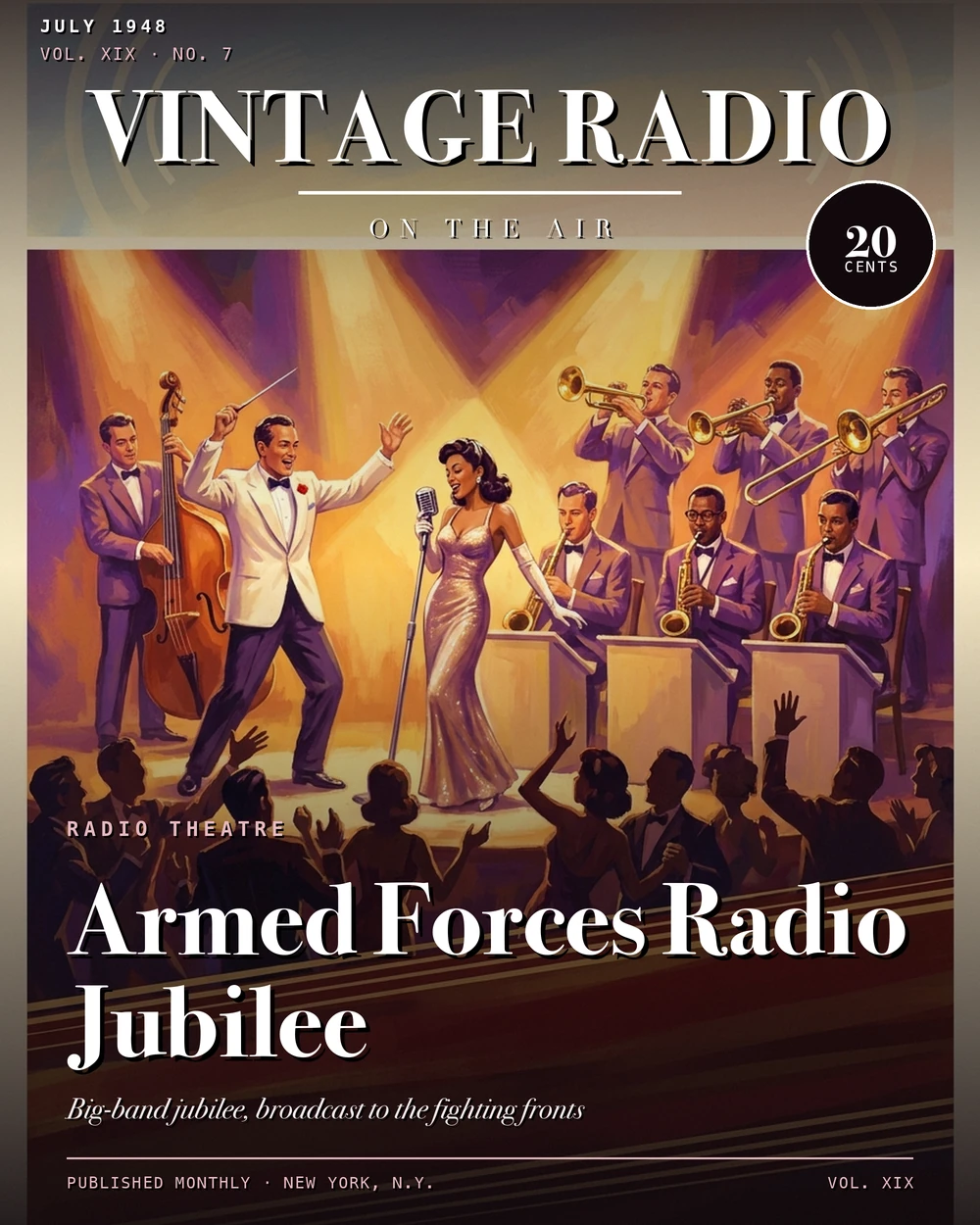
Armed Forces Radio Jubilee
Built for the Troops, Not the Airwaves at Home
Armed Forces Radio Jubilee was conceived in 1942 with a purpose that set it apart from every commercial variety program of the era: it was made exclusively for American military personnel stationed around the world, and it never aired on a regular U.S. commercial network. No civilian audience heard it in real time. The performers recorded before live audiences in Los Angeles — primarily at NBC Radio City in Hollywood and at transcription facilities like C.P. MacGregor and Universal Recorders — and those sessions were edited down from roughly an hour into 30-minute segments, pressed onto 16-inch vinylite discs at 33⅓ rpm, and shipped by priority air to military radio stations worldwide.
The series was the brainchild of Maj. Mann Holiner (1897–1958), a Broadway actor, producer, and songwriter who was commissioned in September 1942 and assigned to the Radio Section of the Army Special Service Division. The inaugural episode aired October 9, 1942, hosted by Rex Ingram, with Ethel Waters, Eddie "Rochester" Anderson, Duke Ellington and his orchestra, and the Hall Johnson Choir on the bill. Captain Charles Vanda, a former CBS west coast programming director, wrote early episodes. Dore Schary, who would later become production manager and eventually president of MGM, also assisted in the early days.
The series launched under the Army Special Service Division Radio Branch, which only became the Armed Forces Radio Service in November 1943. It was cataloged internally as SSD H-11 through October 1943, then AFRS H-11 thereafter. So calling it an AFRS show is accurate for the bulk of its run, but the first stretch — roughly the first 58 releases — was a different outfit doing the distributing, with early episodes going out via OWI shortwave.
What the Show Actually Was
Jubilee is sometimes described simply as a big band and swing program, but that undersells it. The Glenn Miller Archive at the University of Colorado Boulder, which holds recordings from the series, notes that "in addition to big bands, small jazz groups and singers, many talented dramatic and comedic performers appeared on Jubilee." The show mixed full orchestra sets with small jazz combos, vocal solos, comedy sketches, and dramatic performances. The emceeing itself was often comic — the host was as much a comedian as a presenter.
Jubilee was also designed from the start with a specific mission: to showcase African American talent. This made it distinct among AFRS programming. While Command Performance and Mail Call were the other principal AFRS variety series of the era, Jubilee was specifically directed at African American soldiers and drew its early lineups almost entirely from Black performers in Hollywood and the broader entertainment world. It wasn't until early 1944 that white entertainers began appearing regularly, with Johnny Mercer, Jack Benny, and Bob Crosby among the early crossover guests. From that point the series evolved into a consistently interracial program — itself notable for a military broadcast of the 1940s.
One practical consequence of the show's War Department status turned out to be historically significant. The American Federation of Musicians' recording bans of 1942–43 and 1947–48 restricted commercial recording sessions, but those bans didn't apply to War Department productions. That exemption meant Jubilee captured performances that were never made under commercial conditions — sessions that otherwise would not exist on disc.
The Hosts and the Talent
Rex Ingram hosted the first episode, and early shows also featured Mantan Moreland and Dooley Wilson in the role before Ernie "Bubbles" Whitman settled in as the consistent wartime MC. Whitman (February 21, 1893 – August 5, 1954) had a long road before the microphone found him. Born in Oklahoma City — or possibly Fort Smith, Arkansas, depending on the source — he was educated at Tuskegee Institute and ordained as a minister before entering vaudeville. By the time he took the Jubilee hosting chair, he had screen credits in The Green Pastures (1936), Gone with the Wind (1939), and Stormy Weather (1943), among others. His style was broad and warm, well-suited to an audience of service members listening through static on the other side of the world.
The guest roster across the show's run reads like a survey of American popular music in the 1940s. Louis Armstrong, Fats Waller, the Nat King Cole Trio, Tommy Dorsey, Lena Horne, Kay Starr, Billy Eckstine, Louis Jordan, Joe Turner, and Peggy Lee all appeared. So did Jelly Roll Morton alongside Benny Carter. The Fletcher Henderson Orchestra shared an episode with Dorothy Donegan and the Delta Rhythm Boys. Harry James brought his orchestra in alongside Tampa Red and Etta Jones. Bobby Sherwood's orchestra appeared on a bill with Mel Tormé, the Saul Davis Trio, and the Merry Macs. Earl Hines and Count Basie appeared together. Sister Rosetta Tharpe and Lucky Millinder were on the August 2, 1943 episode alongside Jimmie Noone, Butterfly McQueen, and Ida James.
Butterfly McQueen turned up repeatedly — not just a film actress but a recurring comic presence on the show, appearing across multiple lineups. Hedda Hopper made a celebrity appearance. Ray Anthony brought his orchestra in. The Neal Hefti Quartet, the Velvetones, the Pied Pipers, the Page Cavanaugh Orchestra, the Golden Gate Quartet, and the Cee Pee Johnson Orchestra all got their own episodes or shared billing. The variety within a single series was remarkable — one week a full big band, the next a small jazz quartet and a dramatic sketch.
The Run, the Revival, and What Survives
The series ran through the war years and continued afterward, but AFRS discontinued it in 1949. It came back in 1952 during the Korean War, accounting for the episodes from that period, with the last known broadcast dated December 25, 1952. The 92 known episodes in the catalog represent a span that crosses two wars and a decade of American popular music.
The transcription discs were manufactured primarily by Columbia and RCA during the 1942–1945 period. The Glenn Miller Archive at the University of Colorado Boulder holds recordings from the series and treats them as a significant record of American musical history. The series has also been the subject of detailed scholarly discography work — a 1985 discography by Norbert Ruecker, drawing on research by Rainer E. Lotz and Ulrich Neuert, was followed by more comprehensive episode-by-episode documentation from Carl A. Hällström and Bo F. Sherman. Britannica has noted Jubilee as one of the principal AFRS series of the WWII era, alongside Command Performance and Mail Call, specifically acknowledging its role as a program directed at African American soldiers.
What makes those surviving discs more than historical curiosities is the union-ban exemption. For musicians who worked during the recording-ban years, Jubilee sessions sometimes represent the only documented performances of certain repertoire. That's not a small thing. When Fats Waller played Jubilee, the commercial recording industry was shut down. The show's military production status kept the microphones running.